

Integrated Design and Simulation: Multi-Dimensional Design Verification Capability
‘Our solutions are developed through calculation and proven through rigorous validation, not just drafted.’
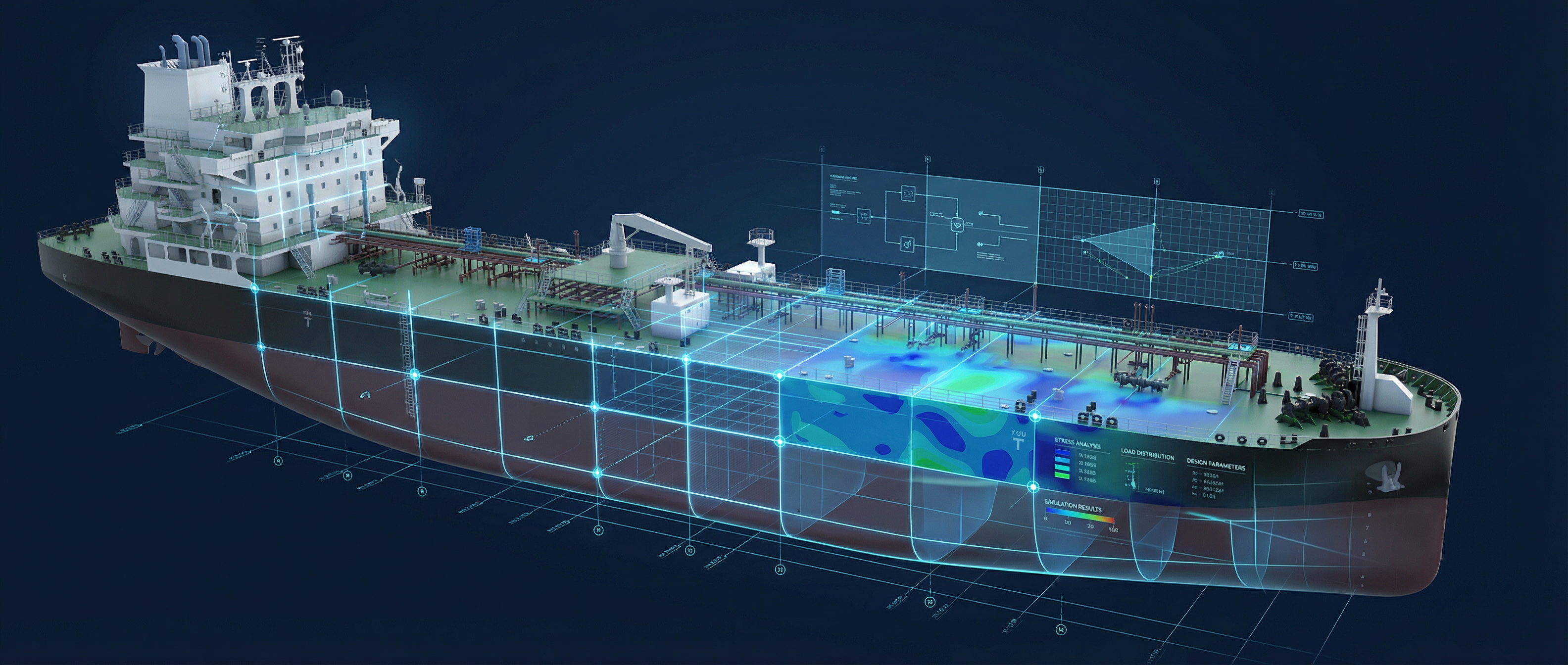
In complex engineering design, the soundness of a design scheme is reflected not only in its geometric configuration and system layout, but more importantly in its performance under real operating conditions. In traditional design workflows, design and simulation are often conducted in isolation, with performance issues typically identified only after the design has been completed. This frequently results in repeated revisions or even the abandonment of the original scheme. To address this challenge, we have established an integrated technical framework that deeply couples design and simulation, shifting performance verification forward into the design process.
Built upon three-dimensional design models, this framework enables multi-dimensional validation of design schemes under various operating conditions and constraint scenarios through a range of digital analysis tools. During the scheme development stage, designers can obtain quantitative or semi-quantitative performance feedback, allowing design decisions to be made with comprehensive consideration of key indicators such as safety, reliability, and operational adaptability. Through virtual testing and multi-scenario analysis, potential issues can be identified early and progressively resolved.
The integration of design and simulation does not aim to perform high-fidelity analysis on every detail, but rather emphasizes the application of validation methods with appropriate levels of accuracy at appropriate stages of the design process, providing effective support for decision-making. This progressive, closed-loop design verification approach ensures that design schemes achieve a high level of maturity before entering the detailed design phase, significantly reducing downstream modification costs. Particularly in lashing bridge design, this capability has become a critical technical means of enhancing design certainty.
